Outright failure is uncommon. A meta-analysis of 73 studies covering 16,935 implants found early loss in 3.6%, with surgical trauma and anatomical conditions the most frequently cited causes.
Peri-implant disease is a different story and far more common. A 2025 AO/AAP systematic review found patient-level prevalence of 46% for peri-implant mucositis and 21% for peri-implantitis — so roughly one in five implant patients develops bone loss around an implant at some point.
Those two statistics get conflated constantly. They describe different problems with different timelines and different fixes.
Failure versus disease
Implant failure means the implant is lost or has to be removed. It’s a binary outcome.
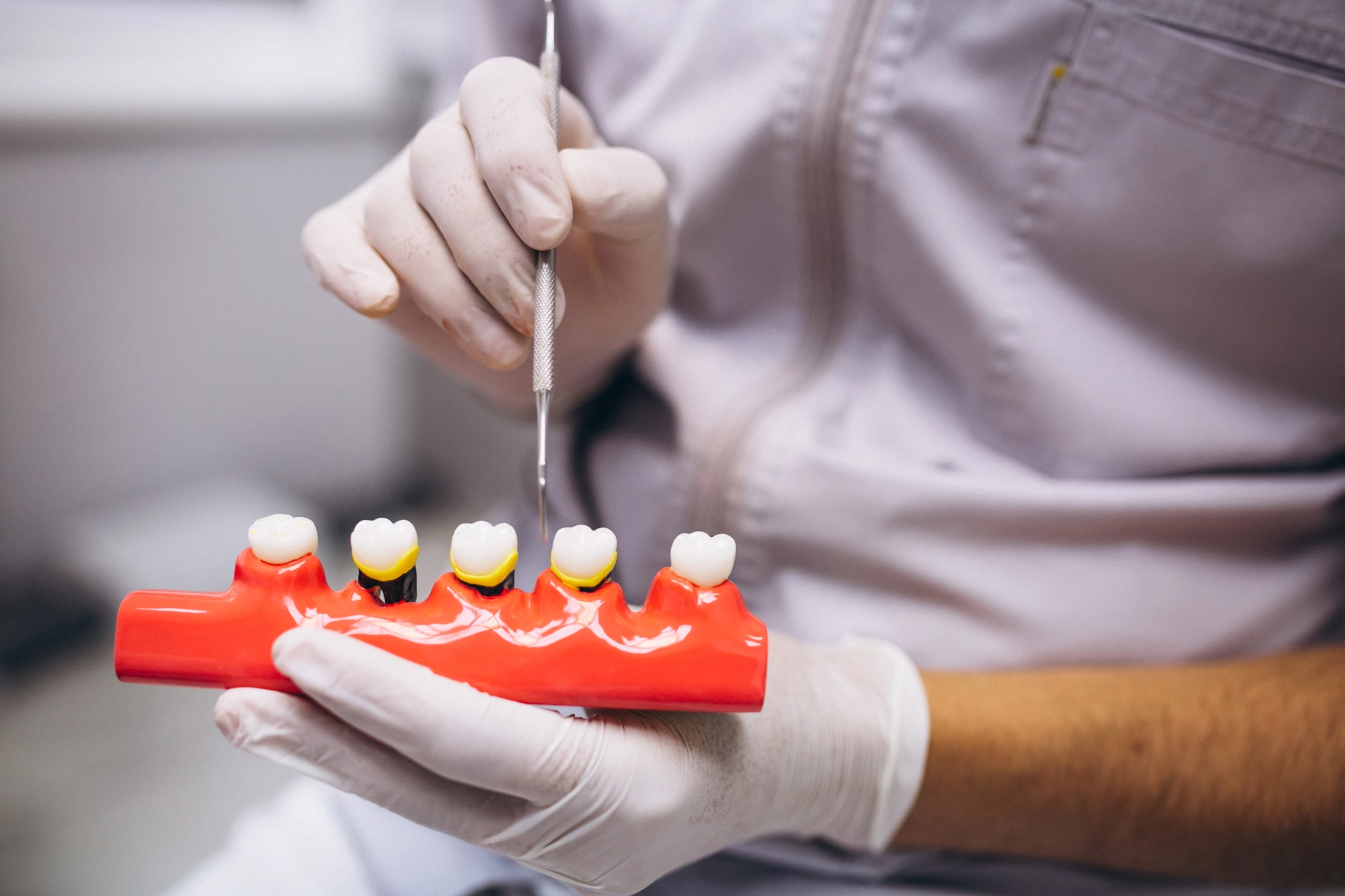
Peri-implant disease means inflammation around an implant that is still in place. It has two stages:
- Peri-implant mucositis — inflammation of the gum around the implant, with no bone loss. Reversible with treatment.
- Peri-implantitis — inflammation plus progressive bone loss. Treatable, but harder, and more likely to recur.
Most implants that eventually fail do so through this sequence rather than suddenly. Which means the useful question isn’t “will my implant fail” but “will I catch the inflammation stage.”
Early failure: before the crown goes on
Early failure means the implant never integrated with the bone — clinically mobile before the definitive prosthesis is fitted. It usually shows up within the first few months.
Causes:
- Lack of primary stability at placement. If the implant isn’t firmly seated in bone at the moment it’s placed, integration may not occur.
- Surgical trauma, particularly overheating bone during drilling.
- Poor bone quality or quantity at the site.
- Infection at the time of placement.
- Loading too soon — the implant moving before it has integrated.
- Smoking.
A meta-analysis of 18,171 implants identified implants shorter than 10 mm, smoking, and placement in the upper jaw as risk factors for early failure.
Early failure is disappointing but usually recoverable. The site is allowed to heal, often with bone grafting, and a new implant placed later. Reputable practices typically replace an early-failed implant at no charge for the fixture — worth asking about before you start.
Late failure: after the implant is in use
This is where peri-implantitis dominates. An eight-year retrospective study of single-unit implants found peri-implantitis and smoking were the principal contributors to failure, followed by bruxism, diabetes, and osseointegration complications.
The mechanism. Bacterial biofilm accumulates at the implant-gum junction. The gum inflames. If that inflammation isn’t resolved, it progresses into the bone, and bone around an implant is lost more readily than bone around a natural tooth — there’s no periodontal ligament to slow it down.
Other late causes:
- Overload from grinding and clenching, or from a bite that distributes force unevenly
- Mechanical failure — screw loosening or fracture, rarely fixture fracture
- Cement residue left under the gum after crown fitting, which acts as a permanent irritant
- Poorly contoured crowns that make the area impossible to clean
The risk factors, with numbers
| Factor | What the evidence shows |
|---|---|
| Smoking | Twice the risk of peri-implantitis at implant level (RR 2.04) and patient level (RR 2.08). Implant failure 6.35% in smokers versus 3.18% in non-smokers |
| History of periodontitis | Increased peri-implantitis risk (RR 2.21). Implant failure odds ratio of 3.02 versus periodontally healthy patients |
| No regular maintenance | Lack of peri-implant maintenance carried an odds ratio of 11.33 for peri-implantitis in a 20-year retrospective study |
| Diabetes | Associated with reduced survival, particularly when combined with other factors |
| Bruxism | Correlated with diminished survival duration |
| Obesity | Identified as a risk factor for peri-implant mucositis in the 2025 AO/AAP review |
The maintenance figure deserves attention. In that analysis, skipping regular implant maintenance carried a larger odds ratio than either smoking or a periodontitis history. It’s also the one entirely within your control, and the one patients are least often told about with any emphasis.
If you lost teeth to gum disease, you are in the higher-risk group. The bacteria that destroyed the bone around your teeth are still in your mouth. That’s not a reason to avoid implants — it’s a reason to have the gum disease treated and stabilised first, and to commit to a maintenance schedule afterwards.
Warning signs
Peri-implant disease is usually painless until it’s advanced, which is why it’s caught at check-ups rather than by patients. Still, these are worth acting on:
- Bleeding when you brush or floss around the implant
- Red, puffy or tender gum at the implant
- Pus or discharge
- The gum receding, exposing metal
- A bad taste that doesn’t clear
- The crown feeling loose, or clicking
- A change in how the bite feels
- Any movement of the implant itself — this is the serious one
A loose crown and a loose implant are completely different problems. A loose crown is often a screw that needs tightening, fixed in minutes. A mobile implant has lost its bone attachment and cannot be saved. If something feels loose, get it checked rather than assuming which it is.
What treatment involves
Mucositis — professional cleaning, improved home care, correcting whatever is making the area hard to clean. Reversible at this stage.
Peri-implantitis — mechanical decontamination of the implant surface, sometimes with local or systemic antibiotics. Surgical access where the defect is deeper, and in selected cases regenerative grafting to rebuild lost bone. Outcomes are less predictable than for mucositis, and recurrence is common, which is the entire argument for catching it earlier.
Failed implant — removal, healing, often grafting, then replacement. Most people can have a new implant, though the timeline extends. Our guide on implants with bone loss covers what rebuilding a deficient site involves.
How to not be in the 21%
Before placement:
- Treat active gum disease first, and get it stable
- Stop smoking, ideally well before surgery and permanently
- Get diabetes controlled
- Insist on 3D imaging so the implant is positioned where it can be cleaned, not just where bone happens to be
- Ask about a night guard if you grind
At restoration:
- Ask for a screw-retained crown where possible, or meticulous cement removal if cemented — retained cement is a known and entirely avoidable cause
- Make sure the crown shape allows a brush or interdental aid to reach the margin
Afterwards:
- Clean around the implant daily, including underneath the crown margin
- Attend maintenance appointments on the schedule you’re given, not when something feels wrong
- Have the bone level radiographically monitored over time
- Report bleeding early — it’s the first sign and the easiest stage to treat
Common questions
What’s the actual success rate?
Survival rates for well-planned implants are high — commonly above 95% at ten years, including in grafted bone. The figure that matters alongside it is the 21% who develop peri-implantitis, because survival statistics count implants still in the mouth, not implants that are healthy.
Can a failed implant be replaced?
Usually, yes. Often with grafting first and a delay. The success rate for a replacement implant at the same site is slightly lower than first time, but still good.
Does it hurt when an implant is failing?
Frequently not, until late. Pain is a poor early indicator; bleeding on brushing is a better one.
Is peri-implantitis the same as gum disease?
Related but not identical. Both are driven by bacterial biofilm, but bone loss around implants tends to progress faster and respond less predictably to treatment than around natural teeth.
Will my insurance cover treating it?
Varies widely, and treatment of peri-implantitis is often classified differently from the original implant. Ask before you need to know.
Does the implant material matter?
Less than the marketing suggests. There is currently no clinical evidence that zirconia implants outperform titanium at preventing peri-implantitis, as our guide on zirconia versus titanium covers.
I’ve had an implant for eight years with no check-ups. Should I get it looked at?
Yes. Bone loss progresses silently, and a radiograph tells you where you stand. Eight years without assessment is exactly the pattern associated with the highest peri-implantitis odds.
Do implants last forever?
No implant comes with that guarantee. Well-maintained implants frequently last decades; poorly maintained ones in high-risk patients may not last ten years. The variable is mostly maintenance, not the implant.