If jaw pain, clicking, or locking has worked its way into your daily routine, you’re probably wondering what can help and whether surgery might be the answer.
TMJ disorder is more common than many people realize, but it’s also one of the most misunderstood. It can affect how you eat, speak, sleep, and live comfortably. And when basic treatments no longer bring relief, surgical options often come into the picture.
For patients dealing with ongoing TMJ symptoms, we typically consider two surgical routes: TMJ arthroscopy and open-joint oral surgery. Each has a unique role, depending on what is causing the problem and the gravity of the situation.
Early intervention can reduce discomfort and protect your jaw’s long-term function. In this article, we will explain the distinctions between these surgeries and help you decide which option is best for you.
What Is TMJ Disorder and When Is Surgery Considered?
Your temporomandibular joint (or TMJ) connects your jaw to your skull and helps you speak, chew, and move your mouth. When this joint isn’t working properly, it can cause immense jaw pain, clicking or popping sounds, jaw locking, headaches, and even tension in your face or neck muscles.
TMJ disorders can be caused by a wide range of reasons, including:
- Trauma or injury
- Malaligned bite
- Disc displacement or arthritis
- Chronic grinding or clenching (bruxism)
We initially attempt conservative measures like night guards, Botox, physical therapy, or medication. However, when pain continues after therapy, or the joint starts to deteriorate or severely limit movement, surgery can be an alternative to restore comfort and function.
TMJ Arthroscopy: Minimally Invasive and Highly Effective
When nonsurgical measures cease to provide relief, TMJ arthroscopy is frequently the first option we evaluate before proceeding with more extensive procedures.
What It Is
TMJ arthroscopy is a minimally invasive type of oral surgery that allows us to correct issues within the jaw joint without making large incisions. With a small camera and micro-instruments passed through small incisions, we can visualize what’s happening and make precise repairs at the source.
Who It’s For
It’s an excellent choice for patients with joint inflammation, slight disc displacement, or scar tissue. TMJ arthroscopy is usually our initial recommendation for surgery; it enables us to address the issue without disturbing the surrounding tissues.
Advantages
Because this is a minimally invasive method, healing is faster and less complicated. It also ensures less scarring, shorter recovery time, and reduced risk of post-surgery complications.
Open-Joint Surgery: A More Extensive, But Necessary Option
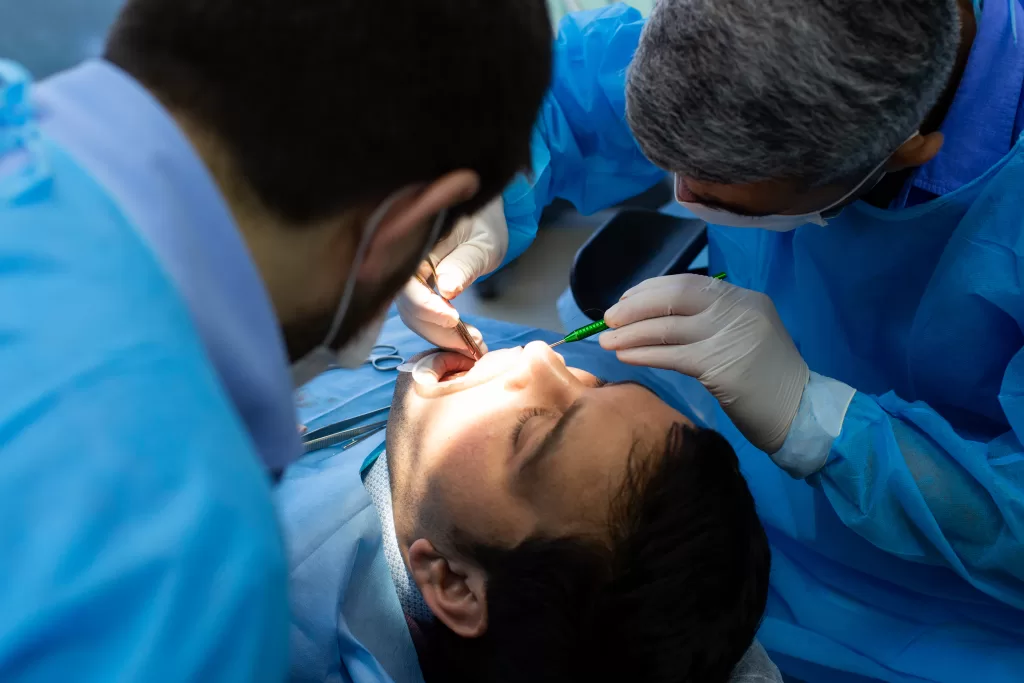
Though less invasive procedures are usually the first choice, certain TMJ conditions require aggressive treatment, particularly when the joint is badly damaged or past treatments have failed.
What It Entails
Open-joint surgery offers us complete access to the joint via a small incision close to the ear. This makes disc repositioning, excision of scar tissue, or, in extreme cases, a total joint replacement possible.
When It’s Needed
We usually suggest this course when there is:
- Severe joint damage
- Tumors or ankylosis
- Severe scarring or prior failed surgeries
What to Expect
Healing takes longer, and there can be a noticeable scar. Depending on the situation, we may need to use bone grafting or insert an artificial disc.
While more invasive than TMJ arthroscopy, open-joint oral surgery might be the most effective treatment option in severe TMJ cases when maximum access is required.
Comparing TMJ Arthroscopy vs. Open Surgery: What’s Right for You?

Choosing between TMJ arthroscopy and open oral surgery is not always an easy one; it depends on some important factors. Your anatomy of the joint, the severity of your symptoms, and how you have tolerated nonsurgical care all have a part in making your choice.
TMJ arthroscopy is minimally invasive and usually the very first surgical procedure we would consider. It’s generally successful in treating patients with inflammation, early disc problems, or scar tissue. It also has less of a recovery period and a lower risk of complications.
Yet, open-joint surgery will be necessary in the case of serious damage, including bone decay, failed prior surgeries, or stubborn disc displacement. While greater healing times will be necessary, they permit greater repairs.
At Ridge Oral Surgery, we provide personalized oral health care while ensuring your comfort and safety. We also utilize imaging like CBCT scans and MRIs to get a better picture of what’s happening within the joint. Combined with our oral surgeon’s expertise and your personal health history, these tools help to pinpoint the best long-term option.
Why Choose Ridge Oral Surgery for TMJ Relief
More than the ideal procedure, finding genuine relief from TMJ pain requires the right team. At Ridge Oral Surgery, we pair expertise with compassionate care to help you heal sooner.
Whether you’re well-suited to TMJ arthroscopy or require a more complex oral surgery, we utilize state-of-the-art imaging and diagnostic equipment to develop a treatment plan that’s uniquely suited to you.
We also look beyond the joint itself and address the muscles surrounding it for more long-term relief.
Warren, Bridgewater, and Morristown patients choose us because of our acclaimed results and individualized care.
Whether it’s TMJ arthroscopy or another more involved oral surgery, we’re here to make it possible for you to move, eat, and smile without pain.