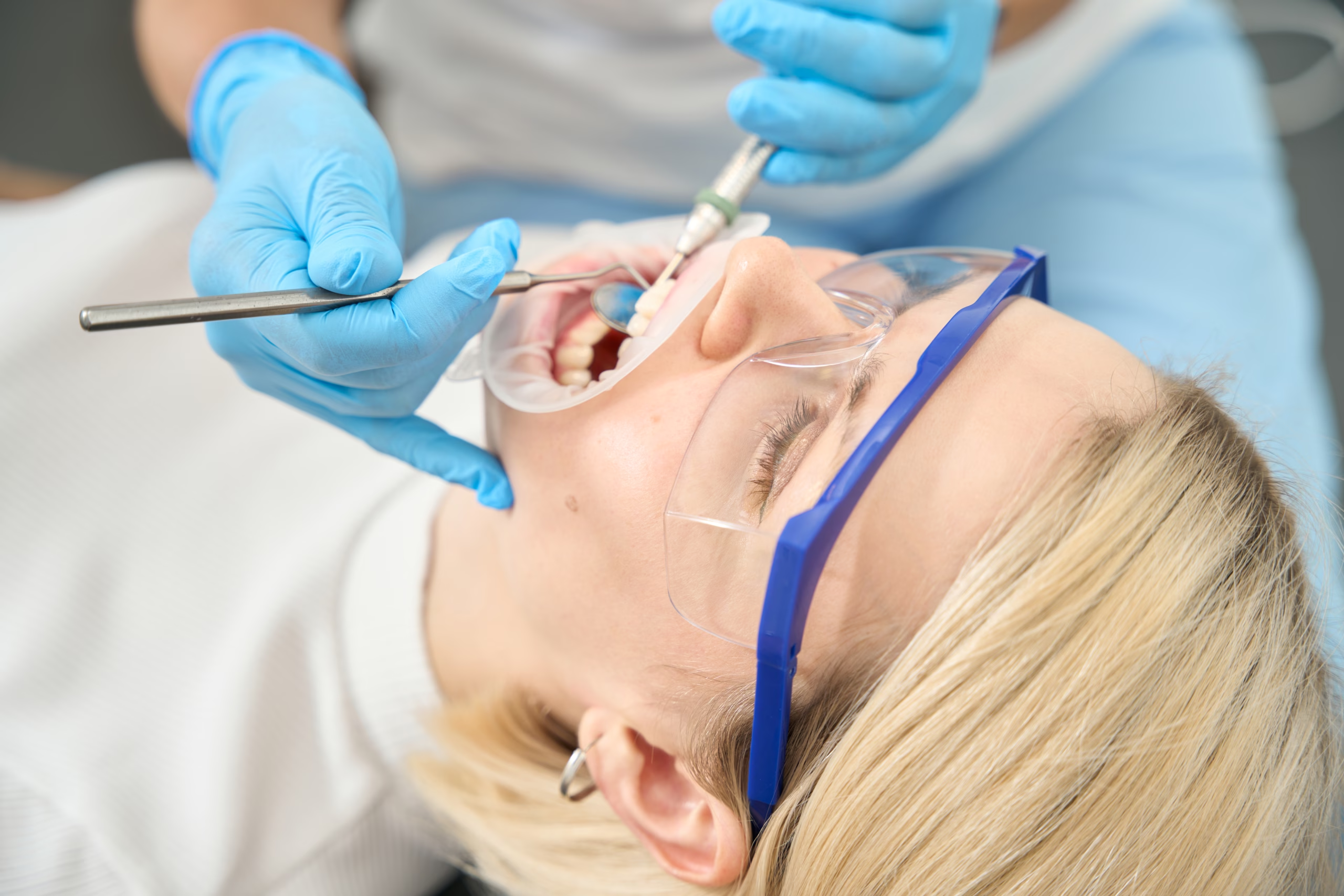
During the procedure, you shouldn’t feel pain. You will feel pressure, pushing and vibration, and that catches people off guard because it’s easy to misread pressure as the start of pain when it isn’t.
Afterwards, expect soreness that peaks around 48 to 72 hours and then eases. Most people manage it with over-the-counter medication, and most say afterwards that the anticipation was worse than the event.
That’s not reassurance for its own sake — here’s the detail behind it.
You’re not unusual for worrying about this
Dental anxiety has a global prevalence of around 15.3%, affecting women roughly twice as often as men. If you’ve been putting off a procedure because of how it might feel, that’s a common reason, not an embarrassing one.
It’s also worth saying plainly: delay usually makes the eventual procedure bigger. A tooth that needs a simple extraction this year can need surgical removal and bone grafting in two.
What you feel during, by anesthesia level
Oral and maxillofacial surgeons are trained across the full range of anesthesia, from local through to general, which is the main practical difference between having a complex extraction done in an oral surgery office versus elsewhere.
| Option | What you experience |
|---|---|
| Local anesthetic only | Fully awake and aware. The area is numb. You feel pressure, pushing and vibration, hear sounds, and feel water and suction — but not pain |
| Nitrous oxide + local | Awake and responsive, but detached and floaty. Time passes faster. Wears off within minutes, so you can drive yourself home |
| Oral sedation + local | Drowsy and relaxed, usually still responsive. Patchy memory of the procedure. You need a driver |
| IV sedation (“twilight”) | Most people remember essentially nothing. You’re not unconscious in the general-anesthesia sense, but you won’t recall it. You need a driver and a quiet day |
| General anesthesia | Fully unconscious. Used for longer or more complex cases, and for patients who can’t tolerate the alternatives |
The commonest misconception is that local anesthetic means “toughing it out.” It doesn’t. It means you’re awake, not that you’re feeling the surgery.
The sensations nobody warns you about
For a procedure under local anesthetic, these are normal and not signs of a problem:
- Pressure and pushing. Often considerable, especially for a firmly rooted tooth. Numbness blocks pain fibres but not pressure sensation — that’s expected, not a failure of the anesthetic.
- Cracking or creaking sounds. Conducted through bone to your ear, so they sound far louder to you than to anyone else in the room.
- Vibration, if a handpiece is used to section a tooth or remove a small amount of bone.
- Water and suction. Noisy. Not unpleasant.
- Your jaw being held open. Often the most tiring part of a longer procedure, and the main source of soreness the next day for some people.
- A warm or odd smell during bone work.
- Your lip, tongue and cheek feeling swollen when they aren’t. A normal effect of the anesthetic.
The thing that distinguishes these from a problem is simple: pressure builds and releases. Pain is sharp, hot and specific. If you feel the second, say so.
About the injection
For most people this is the worst part of the whole appointment, and it’s brief.
What’s done to reduce it: topical numbing gel first, slow delivery rather than fast, warmed anesthetic, and distraction with pressure or vibration at the site. If you have a needle phobia specifically, say so in advance — nitrous oxide or an oral sedative can be given before the injection rather than after.
You’ll be given time for the anesthetic to work, and numbness will be checked before anything starts. The procedure does not begin until you’re numb.
“What if it wears off halfway through?”
You raise a hand, work stops, and more anesthetic is given. That’s the entire protocol, and it’s routine rather than a complication.
Agree the signal before you start. Knowing you can stop things at any moment is, for a lot of anxious patients, the single most useful thing in the appointment.
Some situations genuinely make numbness harder to achieve — an actively infected tooth, where inflammation changes the local tissue chemistry, is the main one. It’s handled with different injection techniques, not by pressing on regardless.
Afterwards: the honest version
| What to expect | |
|---|---|
| Hours 0–4 | Numbness. Take pain medication before it wears off, not after |
| Hours 4–24 | Discomfort builds. Usually manageable |
| Day 2–3 | Peak. Swelling at its worst. Often worse than day 1, which surprises people |
| Day 3–5 | The turn. Noticeable improvement |
| Day 5–7 | Mild soreness. Most people off prescription medication |
| Week 2 | Largely back to normal for routine cases |
Our guide to what’s normal in the first 48 hours covers that stretch in detail.
What you’ll take for it. The ADA’s clinical practice guideline recommends non-opioid medication as first-line therapy after simple and surgical extractions, and found NSAIDs such as ibuprofen — alone or with acetaminophen — more effective for post-extraction pain than opioids. In practice that means most people do better on scheduled over-the-counter medication than on something stronger taken reactively.
What’s not expected: pain that worsens after day 3. That usually means dry socket, and this guide to day-four pain covers how to tell.
Roughly how much, by procedure
| Procedure | Typical experience |
|---|---|
| Simple extraction | Mild. Many people take nothing beyond the first day |
| Surgical extraction of an impacted lower wisdom tooth | The most uncomfortable common procedure. Significant swelling and jaw stiffness for several days |
| Upper wisdom teeth | Considerably easier than lower |
| Single dental implant | Usually milder than people expect — often less than the extraction that preceded it |
| Bone grafting | Moderate, depending on extent and donor site |
| Soft tissue biopsy | Minimal |
| Full arch surgery | Significant for several days, with a longer tail |
Impacted lower wisdom teeth are the honest outlier. If someone tells you four impacted wisdom teeth will be nothing, they’re overselling it.
What makes it worse, and what you can control
Within your control: smoking, which is the biggest modifiable dry socket risk; using straws in the first days; not taking pain medication on schedule; stopping too early; rinsing vigorously; going back to the gym too soon; and arriving dehydrated or having skipped meals.
Partly outside it: how impacted the tooth is, existing infection, how long the procedure takes, your own pain threshold, and anxiety — which genuinely amplifies pain perception rather than just the perception of it.
If you’re anxious, say so when you book
Not on the day. In advance, so it can be planned around.
Practical things that help:
- Choose the right anesthesia rather than defaulting to local because it seems braver. Our anesthesia page sets out the options.
- Book a consultation first. Seeing the room and meeting the team before anything happens removes most of the uncertainty.
- Ask for a stop signal and agree it beforehand.
- Morning appointments mean less of the day spent anticipating it.
- Bring headphones. The sounds bother people more than the sensations.
- Bring someone with you.
We’ve written separately on how oral surgeons help with extraction anxiety.
Is sedation safe?
This is the question that stops some people choosing it, so it’s worth answering directly.
Office-based anesthesia in oral and maxillofacial surgery has a long track record — AAOMS established its Office Anesthesia Evaluation Program in 1975, and deep sedation and general anesthesia in oral surgery offices are estimated to number around 2.8 million procedures annually in the US. One analysis estimated a mortality rate of roughly 1.5 per million anesthetics for the office-based team model in oral and maxillofacial surgery, and the authors noted that figure is likely an overestimate given how the data was collected.
Risk isn’t zero and nobody should claim it is. But it’s low, and the relevant comparison is against the risks of leaving an infected or impacted tooth untreated — which aren’t zero either.
Your medical history determines what’s appropriate. If you take a GLP-1 medication like Ozempic, that affects sedation planning specifically — see our guide on GLP-1 medications before oral surgery.
Common questions
Will I feel them pulling the tooth?
You’ll feel firm pressure and movement. Not pain.
Is wisdom teeth removal as bad as people say?
Impacted lower wisdom teeth are genuinely uncomfortable for three to four days. Upper wisdom teeth and erupted teeth are usually much milder. Most of the horror stories involve the former.
Does getting an implant hurt?
Usually less than people expect. The bone where an implant is placed has relatively few pain receptors compared with the gum, and most patients report a single implant as easier than a surgical extraction.
How long before I can go back to work?
Simple extraction, often the next day. Impacted wisdom teeth, usually two to three days. IV sedation, nothing for the rest of that day.
What if I have a low pain threshold?
Say so. It changes anesthesia planning and post-operative instructions. It’s useful information, not a complaint.
Can I take something before I arrive?
Only what you’ve been told to take. Some medications and supplements affect bleeding or interact with sedation, so check rather than self-medicating — particularly if you take blood thinners, which we cover here.
I had a bad experience before. Will this be the same?
Not necessarily, and it’s worth describing exactly what went wrong — difficulty getting numb, a long appointment, feeling unheard. Each of those has a different fix.