An implant is only as beautiful as the tooth it supports because your final prosthesis truly makes all the difference.
When we refer to implant aesthetics, we are not just placing a fixture in bone. We are thinking about how the artistry and engineering behind your restoration decide how natural your smile looks and feels. Meticulous prosthetic planning ensures that the final restoration matches your face, lips, and smile line.
In this blog, we are going to walk you through how digital design tools, tissue architecture, shade and shape choices, and careful delivery steps come together to elevate your result. Our goal is to help you understand how every detail shapes the smile you take home.
The Aesthetic Equation: More Than a Titanium Post
When we think about what truly makes an implant look natural, it helps to picture an equation built on a few essential pillars.
It starts with the implant position, because that one detail sets the stage for everything that follows. Then we consider shaping the soft tissue, as it frames the tooth and provides a believable emergence profile.
Finally, the prosthesis’s geometry ties the entire look together. All this works hand in hand with your smile dynamics, like lip mobility, the midline, incisal edge display, and phonetics. This, too, is why front teeth demand far stricter precision than molars during esthetic implant design.
Start With the End in Mind: Digital Wax-Up and Mock-Up
When we plan an implant that really looks as though it belongs in your smile, we always start by imagining the completed tooth. Rather than working our way upward from the bone, we reverse engineer the case by designing the ideal shape and then placing the implant to support that vision.
Modern esthetic implant design is built from a digital blueprint of your ideal tooth contours. With tools like 3D smile design, merged CBCT and intraoral scans, and guided surgery, we can bring that blueprint to life with accuracy.
At Ridge Oral Surgery in New Jersey, we also invite you into the co-design process so you can preview the shape and length ahead of time, making sure the final tooth feels just right to you.
Soft-Tissue Architecture: Shaping Pink For Natural White
When we create an implant that naturally blends with your smile, a lot of time is spent shaping the soft tissue. Using provisional restorations with the right emergence profiles helps guide the papillae and the cervical contours so the tooth looks like it grew there.
Tissue thickness and biotype matter too; when the tissue is on the thinner side, a connective tissue graft can enhance symmetry and mask transitions.
We then thoughtfully choose materials. Around sensitive tissue, zirconia often appears more natural than titanium, as it minimizes shine-through, thereby supporting a seamless look around the abutment.
Material Choices That Matter
When we craft your final implant tooth, we want it to look natural, feel comfortable, and hold up beautifully over time. That is why choosing the right material becomes such an essential part of the process.
Monolithic zirconia delivers dependable strength, while layered ceramics offer the lifelike translucency people love. Hybrid materials can work nicely when you want a balance of both. We also pay attention to texture, luster, and tiny micro-layering details so the tooth reflects light like real enamel. And of course, factors like stain resistance, longevity, and how the material behaves against opposing teeth all guide our crown considerations to ensure a predictable, long-lasting result.
Abutment and Crown Details That Make or Break Aesthetics
When we refine the final look of your implant, we focus on the small design choices that shape how natural the tooth appears.
Custom abutments give us better control over the emergence profile and help us place margins where the tissue will look its best, while stock options can still work well for straightforward cases. We also decide between cement-retained and screw-retained crowns based on access, retrievability, and how cleanly we can manage any excess material. Margin placement matters too because it protects the tissue and hides the transition. Thoughtful abutment and crown considerations prevent gray lines, bulkiness, and asymmetric gum lines.
Occlusion and Function: Beauty That Bites Correctly
Once the tooth looks the way it should, we take the time to make sure that it acts the way it should, too.
First, we’ll calibrate your bite so the implant and ceramic are well-protected during everyday chewing and movement. We check how your teeth meet, how they glide, and how the new tooth fits into your natural rhythm. We discuss nightguards if you clench or grind, and we factor that in when selecting materials that can withstand the extra load. Provisionals also give us a chance to test sounds like F, V, and S, so everything feels comfortable before we finalize your restoration. It is all about creating a smile that looks great and functions effortlessly.
Single Tooth vs. Multi-Unit and Full-Arch Aesthetics
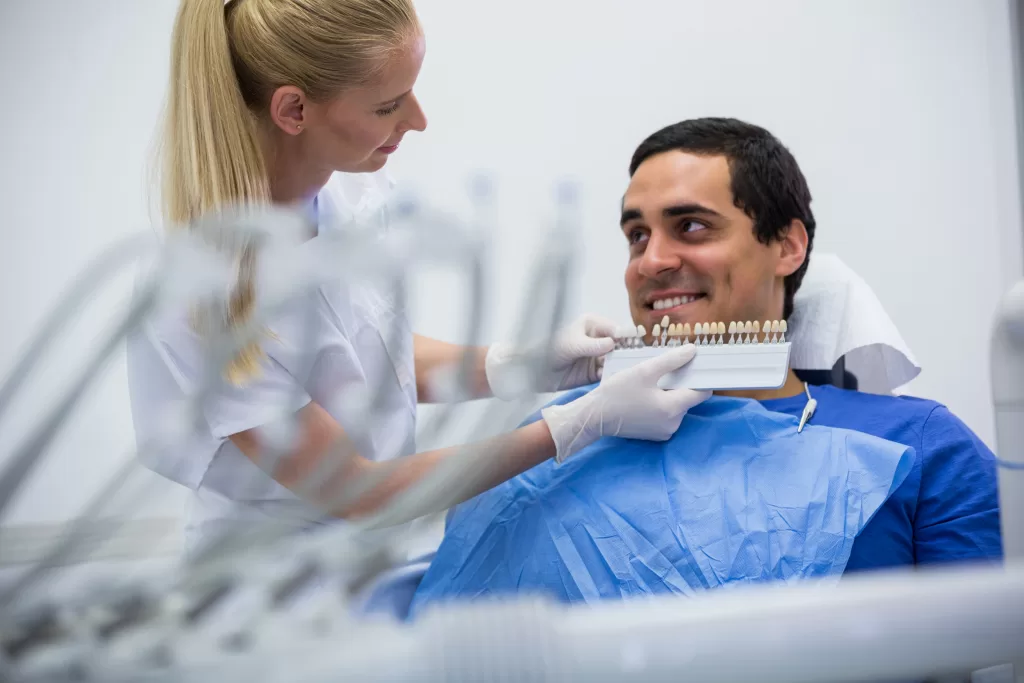
Matching a single front tooth is always a careful, artistic process. We study shade mapping, tiny mamelons, and natural surface texture to ensure the new tooth blends in and doesn’t draw attention.
When we design multi-unit bridges in the front, we focus on connector shapes and pink-white balance to keep everything looking harmonious. Full-arch cases require even more planning because tooth selection, midline position, buccal corridor fullness, and lip support all contribute to your final look. In full arch cases, disciplined prosthetic planning controls lip support and smile fullness.
Delivery Day: Quality Checks and Fine-Tuning

Delivery day is when everything comes together, and we make sure your new tooth feels as good as it looks.
We start with a relaxed try-in to confirm the shade and shape, check for tissue pressure points, and ensure the floss passes easily. A quick radiograph helps us verify the fit underneath. For screw-retained restorations, we torque the implant to the recommended value and seal the access before making any final bite adjustments. We also take photos for documentation.
Before you leave, we walk you through home care, the hygiene tools that work best, and the recall schedule to keep your implant healthy in the long run.
Our Approach To Predictable, Natural-Looking Results
In working towards an effortless smile, feeling completely one’s own, we take a wholly collaborative approach from start to finish. Closely partnering with our lab, we share digital libraries, detailed shade photos, and custom staining notes so that every detail matches your natural teeth.
At the Ridge Oral Surgery clinic, the chairside provisionalization allows us to gently guide the tissues into the right shape before proceeding to the final restoration. Once delivered, we support you with a maintenance plan to protect peri-implant health and keep everything stable. We combine esthetic implant design with customized abutment and crown considerations for seamless smiles.
Choose a Better Smile, Choose Ridge Oral Surgery
Creating a beautiful implant is about designing that final smile from the very beginning. When thoughtful prosthetic planning combines with careful tissue shaping, the right materials, and a precise delivery process, the result is a natural-looking, comfortable, and truly yours.
If you’d like to explore an ideal restoration and what it can look like, we’d be delighted to take you through a personalized design consult here at Ridge Oral Surgery.
Please bring your photos and scans along, and we’ll map out your outcome together.
Book an appointment with us today to visualize your perfect result from plan to placement.