Tomorrow’s operating rooms are here, thanks to 3D and 4D printing.
In oral and maxillofacial surgery, we are on the cusp of an exciting time, where technology and precision converge. With 3D printing, we’re able to print patient-specific models, implants, and guides to surgery that are custom-fitted to every case. That equates to more accuracy and fewer surprises in treatment.
4D printing takes it a step further by incorporating adaptive, time-sensitive properties that change within the body, something that was unthinkable before. The combination of 3D dental imaging with 3D/4D printing is changing the face of oral and maxillofacial surgery.
Above all, these technologies result in safer surgeries, faster recovery, and reproducible outcomes that actually enhance patient care. In this blog, let us explore the future of 3D/4D printing in oral surgery.
The Role of 3D Printing in Modern Oral Surgery
In the modern era of oral and maxillofacial surgery, 3D printing has revolutionized the way treatments are planned and executed. With this, you can design a surgical guide specifically for an individual patient.
It provides us with unprecedented precision during procedures. We can also design precise anatomical models that make training and surgical planning clearer, not only for us but also for patients. The most outstanding achievement is the creation of implants and scaffolds that are customized to fit and facilitate quicker healing.
The benefits are obvious: less operating time, greater precision, and enhanced patient confidence due to the ability to see it before undertaking it. With the integration of 3D dental imaging and 3D printing, we are taking contemporary surgical care to a higher level.
How 3D Dental Imaging Fuels Innovation
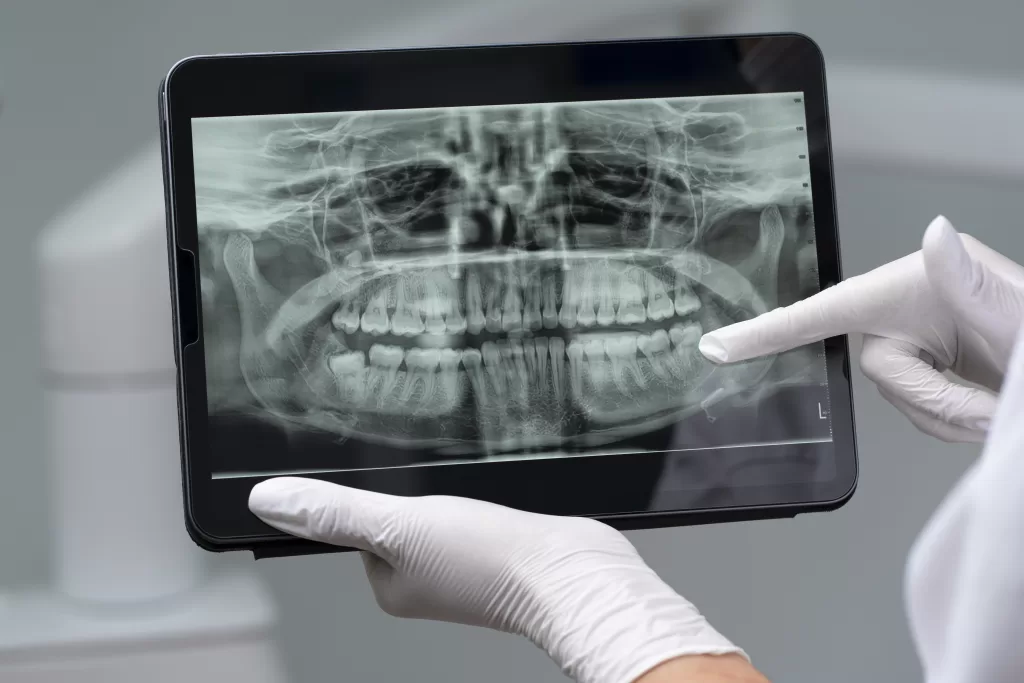
Each process of 3D printing in oral and maxillofacial surgery is initiated with imaging. At Ridge Oral Surgery in New Jersey, 3D dental imaging is the blueprint that makes anything possible.
When we pair CBCT scans with digital impressions, we have a precise picture of a patient’s anatomy. Such precision provides us with the confidence to plan every step with accuracy. What adds to its worth is that surgeons can practice the whole procedure before even entering the operating room.
Let’s consider implant placement as an example. With pre-printed guides, we know the implant will be placed precisely where it is supposed to, with minimal margin for error. Without 3D dental imaging, the precision of 3D-printed surgical models would not be feasible. This combination of imaging and printing is making surgery safer and more predictable.
The Emergence of 4D Printing in Oral and Maxillofacial Surgery
While 3D printing has already changed oral and maxillofacial surgery, 4D printing is stepping up the potential. Basically, 4D printing is 3D-printed items that transform or perform a function as time goes on after being subjected to stimuli like heat, water, or movement. Imagine revolutionary scaffolds that transform over time as bone heals, supporting the body’s natural healing process.
Another thrilling application is shape-shifting implants that will change as children and adolescents grow, decreasing the likelihood of future surgery. Many of these concepts remain to be validated in research laboratories and early clinical trials, but show tremendous potential.
As technology continues to advance, it may enable treatments to be more adaptive, tailored, and patient-specific than ever before.
Real-World Impact on Surgical Outcomes
The most powerful way to understand the potential of 3D and 4D printing is to witness it transform lives. Consider, for instance, complex jaw reconstruction.
With bone graft scaffolds printed in 3D tailored to a patient’s individual anatomy, surgery is reduced and recovery assured.
In children’s applications, adaptive implants are even more breathtaking. They can be altered as a child grows older, resulting in less stress and surgery for the patient and their family.
The advantages are clear: shorter surgery time, fewer complications, and faster healing. Patient-specific innovation is transforming oral and maxillofacial surgery, from implants to bone-guided regeneration.
What once was considered to be something from the future is today becoming a reality, and the outcome is proving to be absolutely life-changing.
Challenges and Limitations
As thrilling as 3D and 4D printing are, they are not without their challenges.
The first is usually costly. The machines and the software are expensive, so not all clinics can simply implement them. And then there are material restraints. We have to have materials that are long-lasting and biocompatible so that they will not be harmful to the human body over the long term. Regulatory clearances also come into play in a big way.
For example, printed implants are subjected to rigorous testing, such as FDA approvals, before being used widely. Additionally, surgeons must be trained to handle these devices, which requires time and effort. These drawbacks do not diminish the potential of the technology; instead, they serve as a reminder that development must be done slowly and painstakingly.
The Future: Where We’re Headed
When we look at what the future holds for oral and maxillofacial surgery, we are entering an era of new possibilities.
Bioprinting is one of the most intriguing fields. Picturing being able to print with living cells to make tissues that might be used to replace injured structures sounds like something out of science fiction, but the research is already heading in this direction. There will also be a greater role for artificial intelligence, with systems that enable the direct design of surgical guides from imaging data and planning that is faster and more accurate.
Eventually, these technologies will not be limited to uncommon cases. They will be a normal aspect of daily oral surgery. The combination of AI, 3D dental imaging, and adaptive 4D printing will revolutionize the future of oral surgery and transform patient care.
Ridge Oral Surgery’s Vision
At Ridge Oral Surgery, the future of care is finding a way to integrate technology to make treatment safer and more accurate.
We’ve already implemented advanced imaging and digital planning, enabling us to enter every procedure with increased confidence and clear vision. As 3D and 4D printing continue to reach more markets, we are excited to integrate these technologies into our practice. They hold the key to customized solutions that can revolutionize patient outcomes.
At Ridge Oral Surgery, we envision oral and maxillofacial surgery advancing with digital planning and 3D/4D technology. Our commitment is to continually innovate, ensuring that our patients always benefit from the latest, safest, most efficient, and most advanced surgical options.
To learn more about how these cutting-edge techniques can enhance surgical planning, contact Ridge Oral Surgery and experience the future of surgical planning today.